
What do we do when logic and intuition collide?
One day several weeks ago, I was perusing my favorite mud puddle for animal tracks when I came across something extremely odd.
The mud puddle, which is more like an inland, mini-mudflat that lies next to a small stream in the floodplain between two ridges, is a great place to practice tracking. I’ve found pawprints of raccoons, squirrels, opossums, deer, coyotes, and even, once, a skunk.
On this day, though, I found tracks that didn’t seem to belong to any of those animals. They looked like tiny feline tracks, like those of a domestic cat. Only this place is over a half-mile from the nearest house and filled with potential predators who could make like difficult for someone’s pet. It was very strange, and an unlikely place for Milo to go adventuring, but who was I to judge?
I took measurements and pictures so I could journal the cat tracks and went on my merry way.

A Much Bigger Mystery
But the next time I went to the mudflat, things got stranger still.
The cat-like tracks were back, only this time they were bigger, and there were more of them. They crisscrossed each other, came and went in every direction, and covered at least three hundred square feet of floodplain.
Even more confounding—they were too big to be made by a domestic cat.

I ran through the list of possible animals who could have made them. They were roughly the right size and shape for bobcat, but this spot is in the middle of a very large metropolis. It’s filled with wildlife, but it’s a half-mile from the VA hospital and a high school, and closer still to a major university. A bobcat passing through would be extremely unlikely.
Gray foxes are known to leave tracks that are more cat-like than other canines. They also have smaller paws. But similar to bobcats, they’re quite rare, and the likelihood of one or more being in this area was incredibly small.
Not to mention the fact that neither bobcats nor gray foxes are known for gallavanting around in the way the many crisscrossing tracks suggested.

Who in the world?
Help from an Unexpected Ally
I get homesick sometimes. It’s taken me a long time to figure out why, because it’s not a desire for a particular place or community. It’s more of a longing for a way of being, a felt-sense, a part of me—or, perhaps more accurately, the whole of me.
There are times when I feel utterly safe and at peace, as if everything is as it needs to be and nothing in the world can harm me. I get that I’m a small but important part of a larger, sacred whole. And I’m filled with love for myself and everything else—which, in these moments, I recognize is really one and the same thing.
When I recall these moments from my more frequent experiences of isolation, stress, or anxiety—from the disconnected state that is our cultural norm—I feel homesick.
I’ve come to realize that at least part of what I’m really longing for is connection to my larger self—the self that’s infinite, loving, and innately connected to everything all around me. Nine days after seeing the larger, cat-like tracks and being flummoxed by who could have made them, I was practicing letting this larger self lead by setting the intention that the me who loves without fear and knows without thinking would guide my steps toward whatever experience would serve the greatest good. I then followed my body wherever it wanted to go.
As my body led me up the opposite side of the ridge from the mudflat, a movement in the trees ahead caught my eye. It was a coyote, one of only four I’ve seen in the area in the last six years. They (there was only one, but I don’t like to refer to animals as “it”) stared at me for a moment, then hopped up onto a fallen tree, turned, and stared some more. After a few moments, they jumped down, then up onto another log, then stared some more.
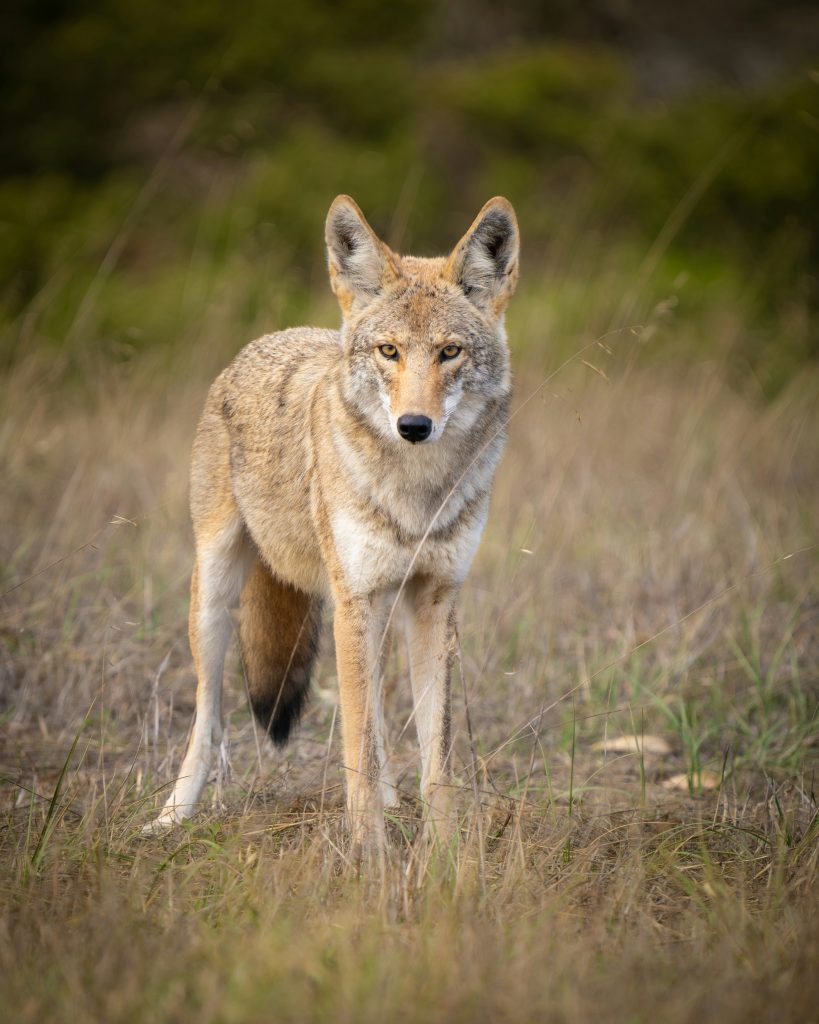
It felt significant in a way I couldn’t explain, but I wasn’t sure what to make of it. When I crossed the ridge and descended to the muddy area to find more of the cat-like tracks, it occurred to me that they could be from coyote pups.
The thought fit like a tailored pair of skinny jeans. I could almost see the pups running, playing and jumping around. Now that I could “see” it, there was so much young coyote energy in the tracks, so much playfulness and joy, that I couldn’t stop smiling the rest of the way home.
Doubt (Always) Enters the Picture
I went home and journaled the tracks, drawing maps, noting weather, sketching prints, and making lists of “why” and “why not” for different possible animals.
And then I met with Sarah, my tracking mentor I introduced in my last post. After looking at my photos and asking a bunch of questions, she pointed out that the tracks I’d found were wrong for coyote. The metacarpal pads were different, the toes were pointed out and much too round, and the animal was moving back and forth in all directions with no clear purpose. Wild animals don’t have endless access to food or fuel, so they have to be more efficient in their movement than the typical household pet. All of this made it much more likely this was domestic dog, not coyote.
I was crushed.
“If these are coyote pups,” she asked gently, “what do you think they were doing?”
I told her about the Disney-like playtime image I’d seen when I was with the tracks, more than a little abashedly.
Sarah, to her credit, didn’t shame me. She just invited me to go back to the area and look for more tracks, possible beds, fur, or a kill nearby—some sort of evidence that my coyote idea was accurate.
Wrapping My Head Around It
After talking with Sarah, I went back to my tracking book and investigated coyote vs. domestic dog tracks more carefully. Everything I saw made me feel worse.
Many domestic dogs are known for having “cat-like” tracks; the tracks I’d seen had negative space in the shape of a C (not an H); and the metacarpal pads were wider than they were long. All of these facts stacked up on top of Sarah’s and heavily pointed to domestic dog.
I finally wrapped my head around the idea that these were dog tracks. It felt like trying to stretch a thick piece of metal around a thin post, but I accepted the truth of it. I even pictured the dog who probably gallavanted these tracks into the mud, even as a part of me felt betrayed by the acknowledgement. It stubbornly whispered, Just because it’s likely doesn’t make it true.
I quickly realized I was in a familiar fight between logic and intuition.
I’ve been in it so many times before—knowing something implicitly without reason, doubting it, then discovering it was true—that I now know I can trust my intuition. Still, in times like this, doubt slips in and I don’t know what to believe.
I realized that if I could get a definitive answer to this particular mystery, it would tell me a lot about what to believe when my intuition says one thing and nearly all the facts say otherwise.
I decided to set up a trailcam to get that definitive answer.
Skipper Dancing
The first night the only image I saw was of an adult coyote carrying prey in their mouth, so I moved the camera to point a different way. When I checked the next morning, there was only one video that wasn’t me clumsily setting up the camera.
It was an adorable coyote pup.
They have their head off camera for the first bit, then turn abruptly and scamper away. The first word (which isn’t really a word) that came to mind was that they were “skipper-dancing.” With their long legs, big feet, and oversized ears, they almost look like a very cute and canine-ish bunny rabbit.
I hooted in surprise and joy. My intuition was right, despite logic, common knowledge, and all evidence to the contrary—the tracks had been made by at least one wild, passionate, and playful coyote pup.
I named them Skipper.
When to Question Intuition
Skipper taught me many things, only a few of which can I put into words.
The first is that yes (yes, YES!), I really (really, REALLY!) can trust my intuition and that deeper way of knowing, no matter the odds. But Sarah and Skipper helped me realize something else—that while we can always trust intuition, it’s important to ground it.
Sarah didn’t tell me the tracks weren’t from coyote pups—she just pointed out that evidence suggested otherwise. But she encouraged me to go look for more evidence that might tell a different story.
You could see this quest for evidence as doubt, but it doesn’t have to be. I can hold intuition as true and sacred while recognizing that that truth might mean something different than I think it does. (It’s always filtered through my very human understanding, after all, which is imperfect and limited even in my most brilliant moments.)
I also think that many times it’s my intuition itself that guides me to do more research, gather more data, or look for confirmation. It might even guide me to bring in other ways of knowing, like logic or analysis. (Unlike reason in recent centuries, intuition doesn’t demand to be the only game in town.)
Getting more information, widening my perspective, being practical, taking exploratory baby steps, and grounding my intuition in the real world don’t make it weaker—as long as I trust the intuitive knowledge, they clarify it, deepen it, and make it more resilient.
How to Trust Intuition
The second big thing Skipper taught me is that just as it’s not helpful to be so uncurious that we forget to ground our intuition, it’s also not helpful to become so doubtful that we don’t let ourselves follow it.
The latter is the side I err on most frequently. Being practical and gathering more data come naturally, but trusting my intuition has taken decades of practice.
A couple weeks after seeing Skipper, I became aware of how frequently I override my intuitive knowing because it’s so faint, vague, and incomplete. Sometimes it shows up with force like the image of the playing coyote pups, but usually it arrives as a whispered breeze in the back of my awareness, so quiet I’ll miss it if I’m not paying attention. It rarely stays long and—most frustrating of all—never explains itself.
Following that quiet breeze feels too tenuous to the (many) parts of me that like to feel certain and in control. They want to make sure I’m thinking things through, making a list and checking it twice, doing everything I possibly can, not following some ethereal, inexplicable, and illogical ghost of sensation.
But I’ve finally realized that it’s my need for certainty and a definitive answer that often keeps me homesick. When I let myself follow the part of me that sensed those coyote pups through their tracks, I feel better, challenges feel less challenging, and amazing things happen that are far better than whatever I had planned.
Because it’s the quiet breeze of intuition—not logic, not certainty, not control—that guides me home to safety and peace and joy and freedom and love for all that is, to who I truly am, time and time again.
The Biggest Gift
It’s huge, this reminder of how to find home, but Skipper’s greatest gift was yet to come. It’s a heartbreaking and powerful one, which I’ll share as best I can in my next post.
Questions for You
- What is the quiet breeze of intuition whispering to you these days?
- What tempts you not to follow it?
- What questions might you ask, information might you gather, or experiments might you run to find out more or ground it in the real world?
- What actions big or small might you take to honor and follow your magical, sacred knowing?
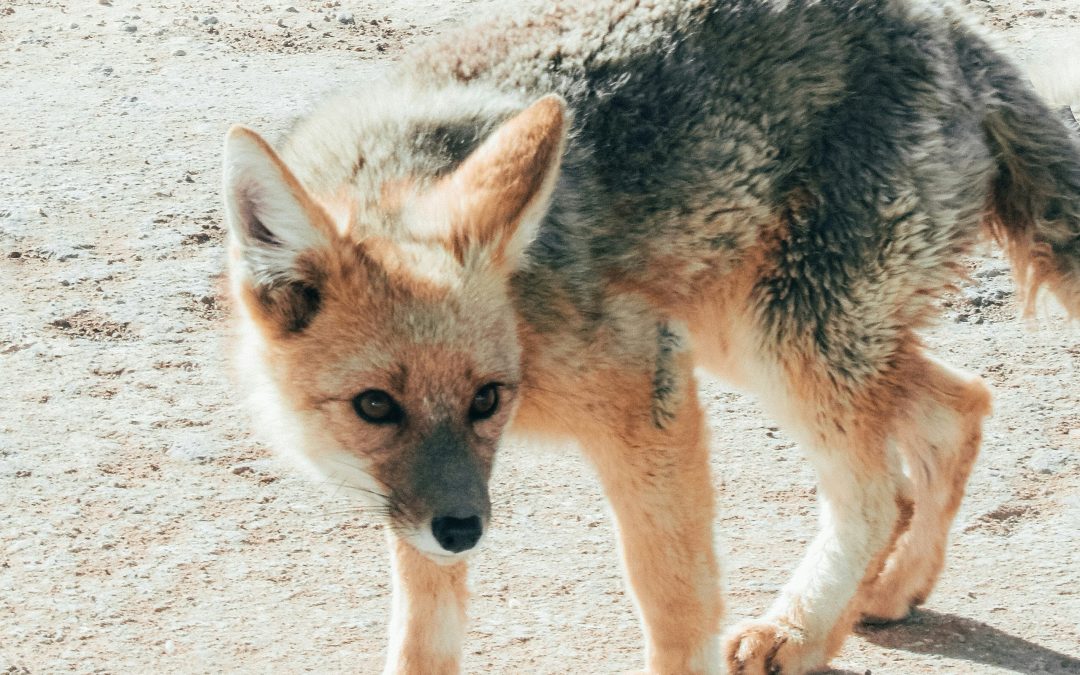
Coyote pup photo by Vinícius Henrique Photography on Unsplash