

We usually get curious about intuition when we need to know something—what to believe, what to choose, what to do—so it’s not surprising that we often forget how critical it is to not know something before we do.
Not knowing, it seems to me, is the first step to tapping into our intuition.
As far as I can tell, it’s like this: intuition is always here, always generously sharing its intelligence and guidance, but our loud thoughts and the many things we think we know usually crowd out its quiet insight.
Only when we admit how much we don’t know does enough space open up for us to hear the soft whispers of a deeper wisdom.
The Benefits of Not Knowing
Admitting how clueless I am has helped me with many things, but it probably transformed my life most dramatically when my husband and I were searching for a new home six years ago.
We’d been house hunting for almost a year in a targeted area within a small radius of our old neighborhood, which we enjoyed, and a park of old-growth forest that I loved and walked in daily.
After a year of nothing feeling right, we were starting to get discouraged, and it occurred to me that maybe we should widen our search area. Maybe there were other neighborhoods we could like that we hadn’t thought of.
Maybe we didn’t know as much as we thought we did about where we ought to live.
A week or so after I widened our search, we got a notification for a house a couple miles beyond where we’d been looking with a lower price, large yard, and creek running through the back.
The house wasn’t love at first sight, but my intuition kept urging me on. It was so insistent that despite a few challenges, several surprises, and loads of fear and doubt, we made the decision to buy it.
I’m so glad we did. The lower price point allowed us to renovate the house exactly how we wanted it. Having such a large yard with a creek has been even more amazing than I imagined. We’re closer to my family, my husband’s work, and tons of restaurants and shops. And while I’m farther from the old-growth forest I used to love, we’re now within walking distance of a much larger nature preserve that wasn’t on my radar previously, where I joyfully walk daily among deer, turtles, otter, osprey, and great blue herons.
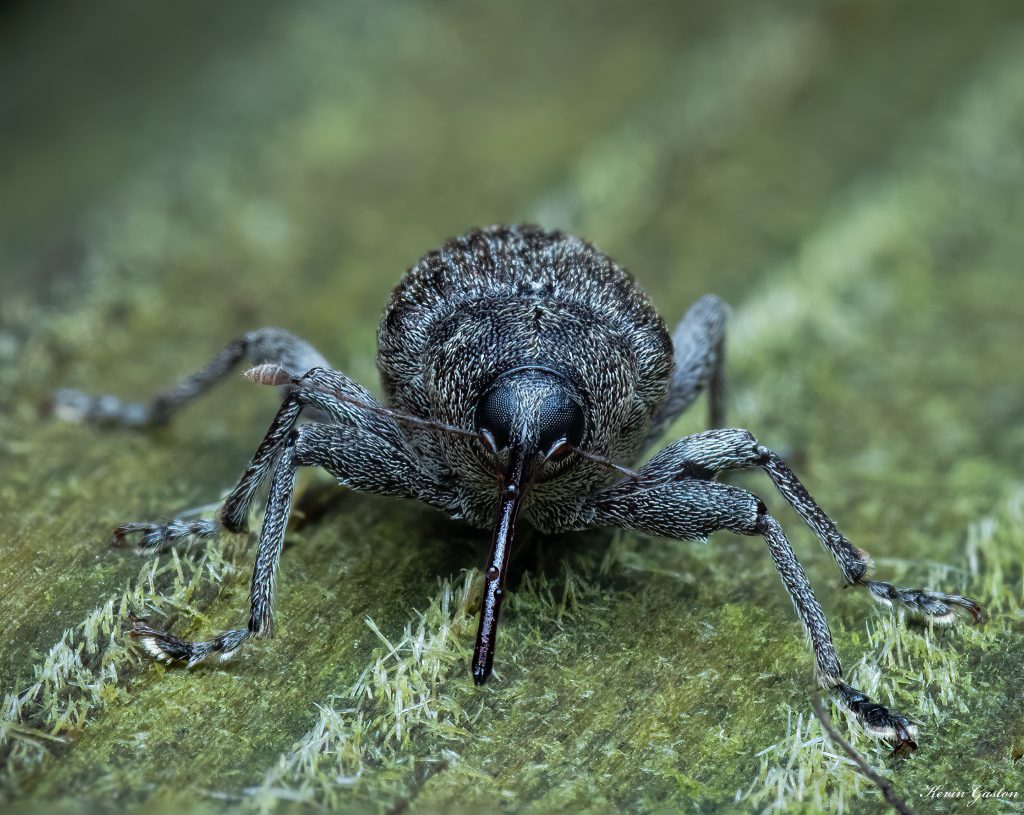
How to Practice Not Knowing in the Natural World
I used to get bored walking the same trails in the same places over and over, until I realized that in nature, nothing is ever the same for long. It’s like the Greek philosopher said:
“No man steps in the same river twice, for it’s not the same river and he’s not the same man.”
–Heraclitus
Similarly, nature is never the same place twice, and because it’s so complex, dynamic, and impossible to comprehend completely, it makes a great place to practice not knowing.
Here are three questions I’m learning to ask to quickly realize how little I know:
1. What’s new in this moment?
Spring is a great time to observe how quickly things can change and render my knowledge irrelevant.
Buds swell, leaves emerge, shoots shoot, petals spread, tendrils unfurl, eggs hatch, cocoons open, snakes uncurl, lizards stretch, chipmunks emerge, overwintering birds leave while other migrants return, and soon their nests appear.
There’s so much shifting with each season, each day, each moment that I can’t possibly comprehend or expect it all. It reminds me to stop thinking I know everything and start wondering what’s true now. And now. And now.
In that mind space, there’s nothing to do but be curious, and delightfully humbled by whatever surprise reveals itself next.
2. What’s too small or too big for me to get?
“I am large, I contain multitudes.”
-The Natural world (just kidding, it was walt whitman)
For a long time, I assumed that the things I usually notice on my walks—the trees, the plants, the easily visible animals—were everything there was to see.
Then I ran into a photographer named Kevin Gaston who showed me some of his photos—of mites, springtails, slime molds, and other creatures so small we can barely make them out with the naked eye (the photos in this post are his, except for the red maple). Turns out, they form an entire, microscopic ecosystem in the soil, and provide essential services like breaking down dead material into nutrients that new plants can use.
What surprised me even more was that these tiny, critical creatures that we almost never see are also often breathtakingly beautiful.
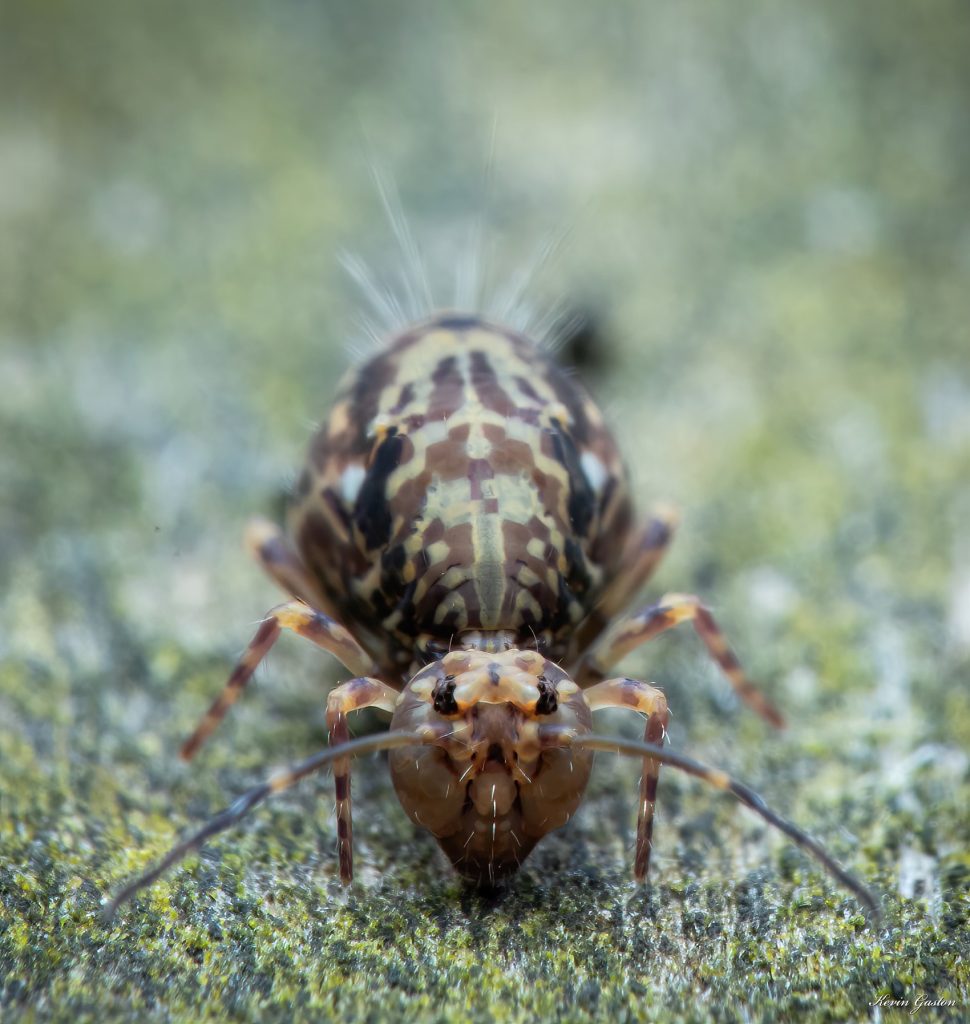
For all the things too small for me to notice, I’m sure there are just as many that are too large—the full journey of the wind, the slow movement of the mountains, the details of planets and moons and stars.
When my brain gets noisy with everything I think I know, I remember the multitudes in nature, how many there are, how few I’ll ever truly understand. Then space opens up—a doorway to intuition—as well as an awareness that despite what I tell myself, anything is possible.
3. How is my perspective limiting what I know?
Recently I was walking along a trail I go down several times a week when for some reason I looked up and saw a red maple in full bloom.
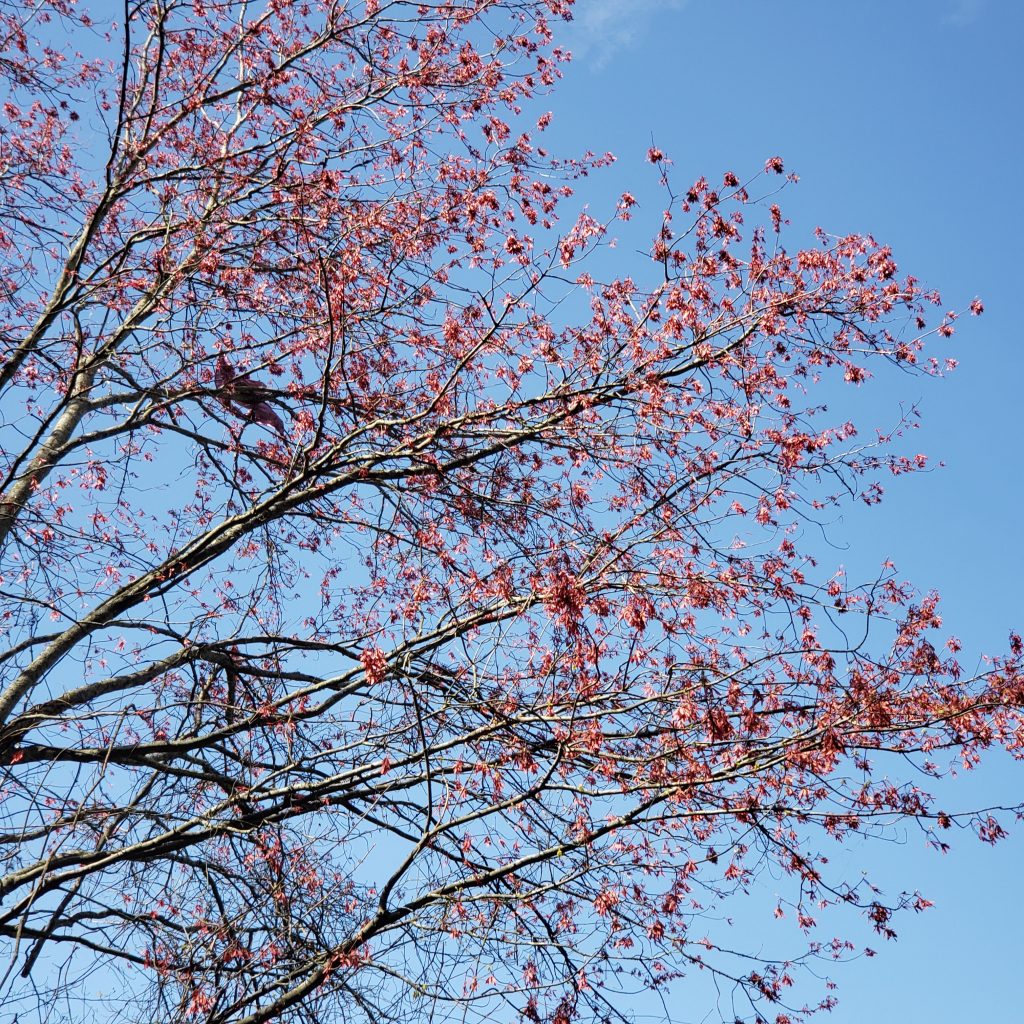
I’ve probably passed by dozens of times while it was blooming over the last few years, but I never looked up enough to notice its ephemeral, scarlet beauty even once.
The same patch of forest looks remarkably different when I’m looking at the ground, where fresh, white bloodroot blossoms arise from last year’s brown leaves; or at eye level, where the solid trunks of trees converse in shades of umber and gray; or high up, where the bright, blue sky expands into infinity past the tips of reaching branches.
When I can’t see the forest for the trees (sorry, couldn’t resist), sometimes turning around, looking up, or looking down can help me understand something differently. Sometimes it just helps me see how much I’ll never understand because of the limits of who and what I am.

And that’s what constantly amazes me. Most of us are taught that we’re supposed to know everything, that not knowing is some kind of personal failure. My experience is the opposite—that not knowing is the natural state of things, and the necessary flip side of what we do understand.
There will always be more that I can’t know than I do. But that’s okay, because mystery makes things interesting, and I don’t have to be sure to be clear.
Share with the Rest of Us
When has recognizing what you don’t know helped you? What mysteries in the natural world have you been wondering about recently? Come share what you’re discovering with the rest of us in the Facebook group I created just for this purpose so we can learn alongside you (https://www.facebook.com/groups/180860054978770).
Click here to receive future A Wild Hunch posts in your inbox on the full moon.
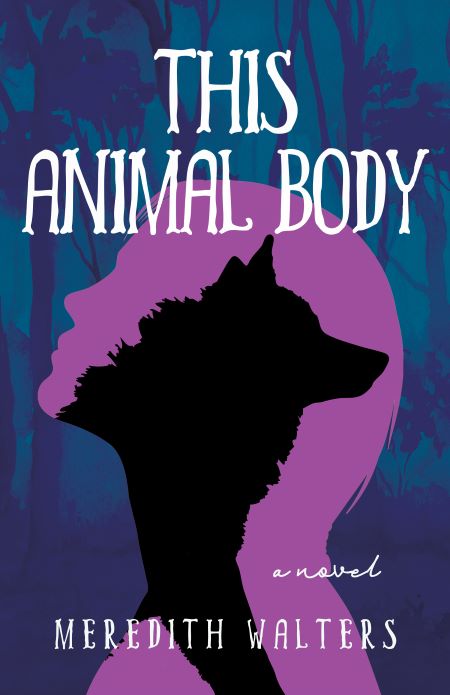
If you enjoyed this post, you might like my award-winning novel.
“Sublimely complex characters drive this story that promotes empathy for all earthly creatures.”
–Kirkus Reviews
Read the previous installment of A Wild Hunch: Ideas for Reclaiming Our Natural, Intuitive Wisdom in the Natural World
Top photo of a broad-headed sharpshooter by Kevin Gaston
Meredith, I came across your inspiring article when I was trying to identify an insect that I photographed today. Kevin’s amazing picture is the only one that is a dead ringer for mine, albeit not in picture quality! My novice attempt to classify it is “Jagged Ambush Bug”. I will take your advice and recognize that I don’t have a clue. Any information about it would be greatly appreciated. Thank you!
Thanks for reaching out, Michael. I also don’t know any more. Kevin only identifies it as an ambush bug, but the links go to his profile on Facebook where he interacts with folks. There’s also a group on Facebook called BugGuide (https://www.facebook.com/groups/19833784207) where you can post photos and get IDs.
I appreciate your timely response, Meredith. I don’t have access to Kenvin’s site, but I have a Bug Guide account on the web. I’ll try sending it in and giving them a shot at it. Thanks!
Of course. Good luck!