I realized the other day I’m in a period of undeniable breakdown.
I’ve been hearing a lot recently about aligning with the seasons and using the cold and darkness of winter as a chance to turn inward, reflect, and rest.
It all sounded great to me, and much-needed, but I somehow forgot the other aspects of winter—the stripping bare, the decomposition, the death.
It’s not just present in the natural world for me right now. My father died a year and a half ago, and last year I lost three of our last four chickens, including one I’d been with for ten years. Recently it feels like my family is changing in fundamental and often painful ways.
I’m feeling the impacts of (middle) aging in my body in reduced strength, difficulty sleeping, and waves of anxiety, overwhelm, and exhaustion.
And then, of course, there’s everything going on in the world right now. I mean, talk about breakdown.
So what’s the magic in all this? And should we even be talking about magic given all the terrible things happening right now?
I’ll answer the second question by examining the first.
The initial bit of magic in all of this for me is that I’m not panicking. Usually when anything goes awry, all my anxious parts go into overdrive figuring out exactly what else can and will go wrong. But one of the advantages of (middle) aging is that I’ve finally spent enough time on this planet to understand that death is never the end if the story.
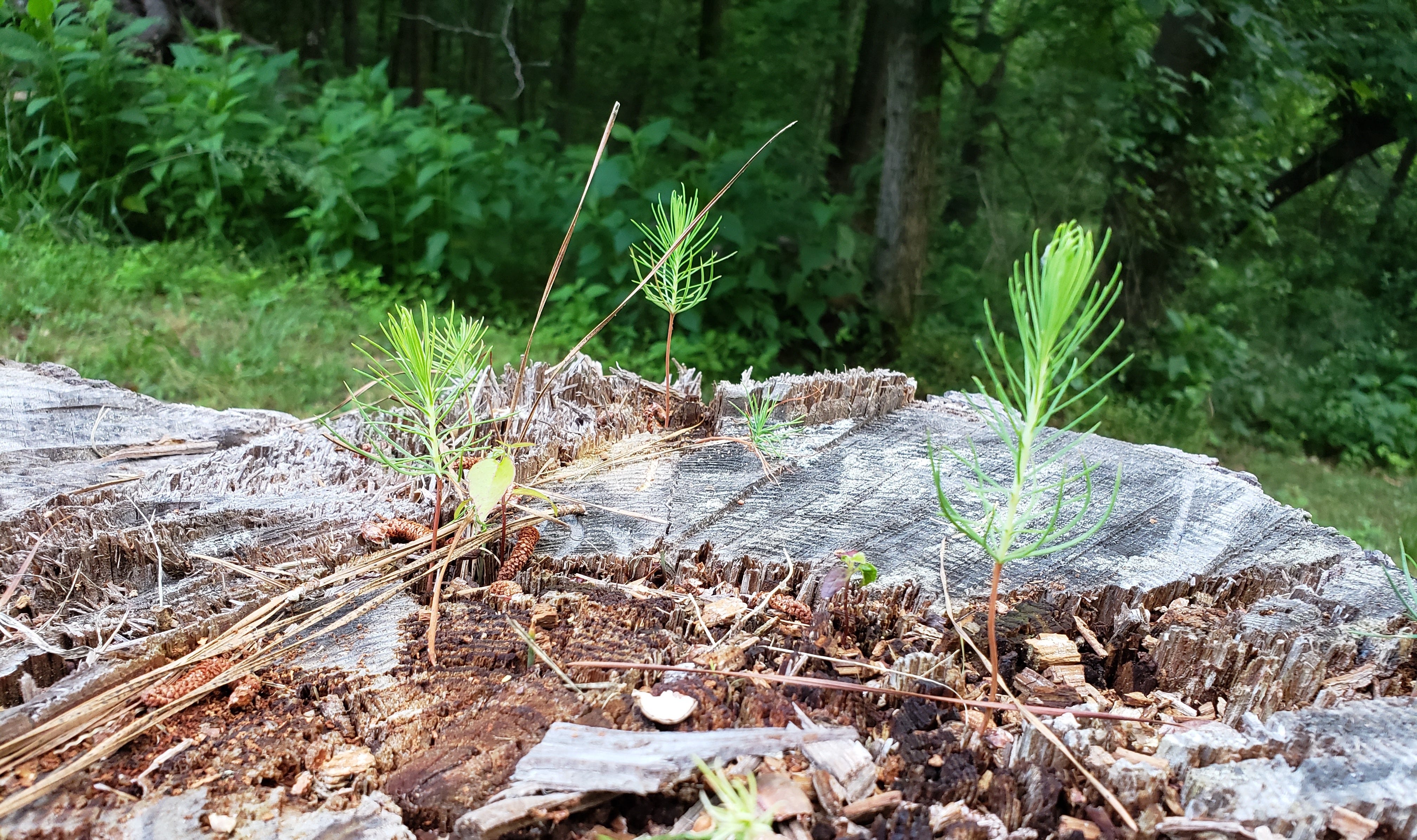
Downed trees known as nurse logs provide a nurturing foundation for the next generation of seedlings. Fallen leaves protect the lives of overwintering caterpillars and break down into nutrients for next year’s plants. In countless ways, the decomposition of winter makes possible explosive new growth in spring.
And that’s the most potent magic here. That death and disintegration always lead to creation. Always.
This isn’t a nurse log, but the baby trees here are drawing on the nutrients of a fallen forbear.
The Magic of Depression
When I was depressed, the pain was so intense at times I thought it would kill me. Even when I wasn’t getting sliced by the knife of despair, I was stuck inside a thick, glass jar where no joy or happiness or anything good could reach me.
I’ve said before depression broke me into a thousand different pieces. But it turns out that was exactly what I needed, because it was only by being shattered that I was able to see what remained. What was left—the part of me that could not be annihilated—was what I had been missing all along.
Depression can have many different causes, impacts, and lived experiences, but in my case, it turns out that multiple layers of beliefs, patterns, and habits had cut me off from my true nature. Depression’s destruction was violent and painful but ultimately swept clear what stood in the way of experiencing my deepest, truest, most resilient and loving self.
Old forms must break down before new ones can be made (or in this case, remembered).
The Magic of Disintegration
I see it with my clients all the time. They arrive frustrated, frightened, or embarrassed by the breakdowns in their lives—by a marriage falling apart, or losing a job, or failing to get a new one.
And then, one by one, they acknowledge their loss, notice the new ground of their lives, and build on it something truer and more meaningful than what came just before.
For my part, even though I’m still in full-on disintegration mode, I can already feel it’s also a time of healing. Old wounds of feeling hurt, abandoned, or unloved are resurfacing all over the place, but so is the clarity and compassion needed to heal them. Glimpses of a new path through the pain are emerging.
Sometimes with the bones of the black sticks left when the fire has gone out someone has written something new in the ashes of your life. You are not leaving. Even as the light fades quickly now, you are arriving.
From “The Journey” by David Whyte
The Magic of Dark Times
There’s even evidence of breakdown’s magical ability to create new and promising possibilities on a global scale in some of the most tumultuous, trying times in human history.
Mindfulness teacher and author Tara Brach points out that in the cases of Gandhi, Martin Luther King Jr, and Nelson Mandela, consciousness evolved and hearts awakened—perhaps even accelerated—in fearful and hostile environments.
“We’re talking about the violence of colonization, we’re talking about apartheid, racial hatred, oppression,” she says.
“There’s a reason that movements of radical love and nonviolence can emerge in hugely stressful times… If we look back through human history, evolutionary scientists believe that stressors and survival dangers are what increased the sophistication of our language and communication, our capacity to reason and the growth of pro-social capacities like compassion, like empathy, like collaboration.”
“Stress can grow us. Like the winds causing trees to grow heartwood and interweaving roots.”
Tara Brach
That’s why we absolutely should be talking about magic right now. God help us if we have to save the world using logic and linear change alone.
Turns out it probably wasn’t Einstein who said it, but the quote remains true:
You can’t solve a problem using the same consciousness that created it.
not einstein
But shifting consciousness isn’t easy, and most people can’t or won’t do it unless forced to by extreme discomfort, pain, or necessity (hence the reason hitting rock bottom isn’t seen as an entirely bad thing in many addiction recovery circles).
I find it somewhat funny that what we need most may be the exact thing most of us have spent so much of our lives trying to avoid.
But I also find it incredibly hopeful that the magic of disintegration and death may be strong enough—may, in fact, be the only thing powerful enough—to transform all the trauma, pain, and negative cycles in our world into healing, wholeness, and love.
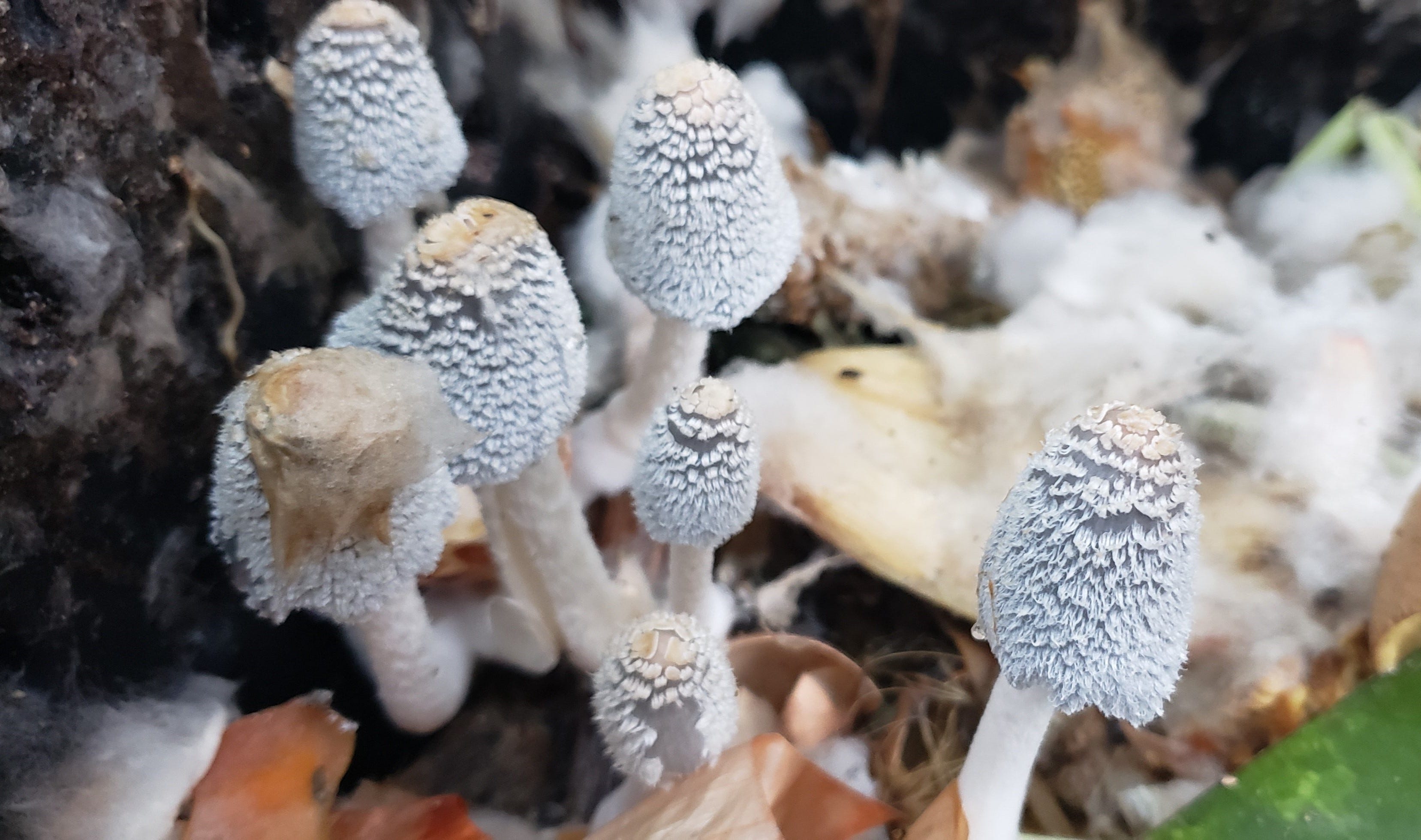
Beautiful fungi grow from our discarded, rotting food scraps
Let me be clear. There’s a tremendous amount of loss and heartbreak in breakdown. We can’t skip over that.
I cry a lot—and by a lot, I mean, most days. Sometimes it’s so much I feel I must be made of sadness.
But I’m not. I always get to the end of it.
And every time I let the raw grief get as big as it wants to, I find something amazing after the tsunami passes through:
Something new.
It might be something big, like a new perspective, possibility, or way of being in the world.
Or it might be something as small as the feeling of being cleansed like a creek bed cleared out by a roaring flash flood, leaving me open to the minute and breathtaking beauty of a dragonfly’s wing, or the tiniest joy floating by on the single, sweet note of a hermit thrush proudly announcing his home.
And that’s the final magic in breakdown, decomposition, and death—that we don’t have to do any of it alone.
Whether it’s mysterious forces we don’t understand, connection to wild beings in nature, the support of the people around us, or the part of us that’s unconditionally loving and unbreakable, assistance is always available to us.
Which is good, because we all need the help. Sitting with what’s rotten is rank, uncomfortable, and at times, overwhelming. It’s also the compost that allows the rarest and most exquisite flowers to grow.