
Master naturalist and expert tracker Jon Young can locate a wild animal in two ways—by observing the physical clues they leave behind, or by using intuition alone.
He demonstrates the latter, which he calls spirit tracking, alongside Anna Breytenbach in the documentary movie The Animal Communicator. As Jon tells the story, they were in a hut in the Kalahari in South Africa waiting out the hottest part of the day so they could film in cooler conditions. Jon (an American) began thinking about his neighbors, who had named their son Eland after an African animal he didn’t know anything about. Feeling a familiar energetic pull in his body, he decided he would spirit track an eland for Eland.
After gathering up Anna and the film crew, Jon followed the energetic pull down a hill and straight to a single, perfect track in the sand. He lay down next to the track, relaxed, gave gratitude, and studied it. The face of an antelope popped up in his mind, as did the knowledge of where it was.
The film crew separated Jon and Anna, who can also spirit track, and asked them where they could find the animal. Both gave the same answer, separately. When the entire crew followed their directions, they came upon an eland (a type of large antelope) lying under a bush, in the exact spot and position Jon and Anna had predicted.
When I first heard this story, I was fascinated. Inspired by the possibility of finding animals using my intuition (two of my favorite things) and curious how spirit tracking could help my clients find their elusive callings, I took a class with Jon Young on the topic. He’s adamant that it’s a natural ability we all share, and that one, simple practice can help us develop it:
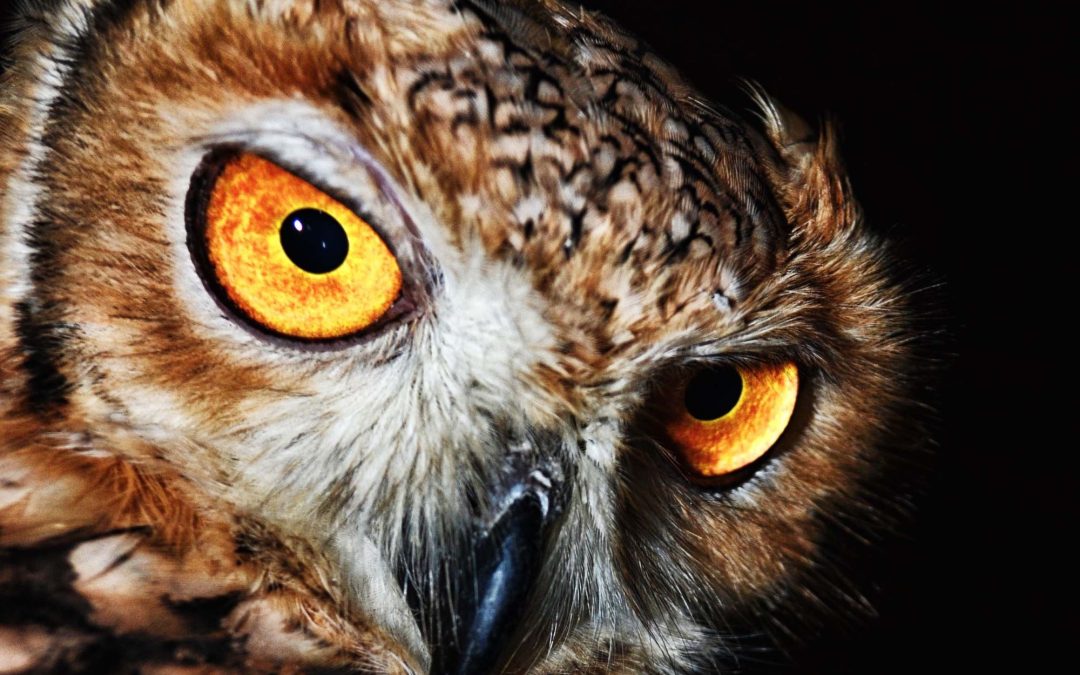
Seeing the world like an owl does.
Our eyes are meant to see things on a spectrum. We can hone in on small things in detail, like birds hyper focusing to recognize seeds on the ground, or we can see the larger picture, taking in our entire peripheral vision, like birds checking their surroundings for potential predators.
We’re designed to frequently go back and forth between the two ways of seeing. But in our modern world of enclosed spaces and device screens, most of us overuse focused vision and rarely take in the periphery. Which is too bad, because according to Jon Young, softening our focus and seeing the periphery—using our “owl eyes” as he calls it—is what develops our intuitive abilities.

I began practicing owl eyes a couple months ago. At first, I made the mistake of trying too hard to get it right. Eventually I realized that, like tapping into intuition, it’s more about relaxing than anything else.
When I relaxed into it, I began to notice that I have a habit not only of over-focusing my eyes, but also my attention. Amidst the many daily demands of modern life, I’m usually narrowly focused on whatever I’m trying to get done—the words on my computer screen, the salad I’m putting together, the chicken poop I’m dutifully scooping out of the coop.
When I experimented with letting my awareness expand alongside my field of vision, I began to find that my nervous system relaxed. When airplanes flew low over our house, I no longer felt so disturbed by the excessive noise. When an obsessive thought arose, it was less tempting to latch onto it.
Then one day I got stuck on a scene in the new novel I’m writing. No words came, or they came excruciatingly slowly, only to feel awkward and wrong. For weeks, I wrote and rewrote and made zero progress.
Finally I went on a walk and practiced owl eyes and expanded awareness. I was increasingly aware of the beings around me—the movement of the squirrels, the singing of the birds, the swaying of the trees, and the smell of newly fallen leaves. I became more aware as well of the energy that surrounded me—the earthy, slowing, strong-but-serene energy of fall. I felt more a part of it all than ever before.
Somewhere on my walk it came to me that I’d started my scene with the wrong action. A slight adjustment occurred to me, and when I went home and tried it, words flowed once again. One small problem unlocked.
I can’t help but wonder how many other problems owl eyes could help with. How many of our individual and collective issues come from an overly narrow focus, activated nervous systems, or not being able to truly sense and connect with the diverse beings around us?
Owl eyes—one of those rare practices that doesn’t require any additional time or energy, that asks us to let go more than make an effort—may be able to help us not only develop our intuition, but also heal ourselves and perhaps the world.
Find Your Own Intuitive Nature
To get a sense of what owl eyes feel like, stretch your arms out to either side and press them back as far as you can. Keeping your gaze relaxed and on the horizon, begin to wiggle your fingers and move your arms forward. Stop when you can see the movement of your fingers out of the corner of your eyes. That’s how wide your peripheral vision goes.
Next, stretch your arms out up and down, with one hand reaching over your head and one parallel to your legs. Again keep your gaze relaxed and on the horizon, wiggle your fingers, and begin to move your arms toward each other. Stop when you can just barely make out the movement of your fingers. That’s how high and low your peripheral vision extends.
To go into owl eyes, simply let your eye muscles relax so that you’re not focused on any one thing. Allow your eyes to take in everything across your field of vision, all the way to the borders you just defined.
You can practice owl eyes anytime, anywhere. I particularly love doing it on walks through parks and other greenspaces. You can also practice an in-between type of vision where you’re focused on something you’re working on but still seeing what’s on the periphery.
I find it helpful to consciously extend my awareness as well as my vision, which often involves tapping into my other senses and listening for sounds in all directions around me.
I would love to know what this is like for you! I’ve created a group on Facebook so we can receive each other’s stories. Please go to https://www.facebook.com/groups/180860054978770 and share your experiences there.
PS If you’re wondering if I’ve yet to successfully locate an animal using only my intuition, the answer is: not like Jon Young. Not yet. But maybe a little bit? I’ll share the story in the next Wild Hunch and you can decide for yourself.
Click here to receive future A Wild Hunch posts in your inbox on the full moon.
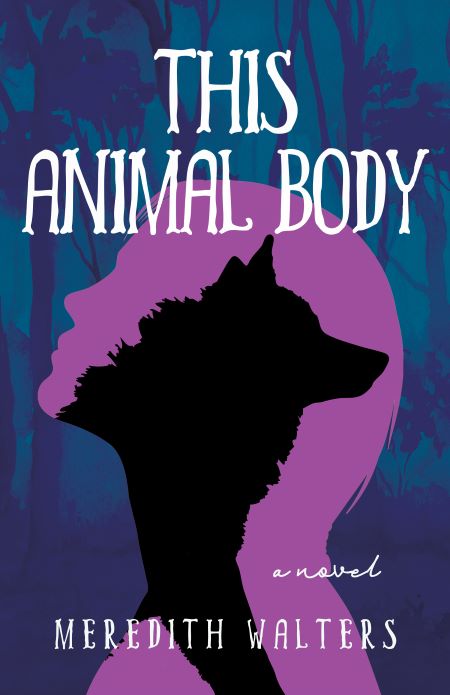
If you enjoyed this post, you might like my award-winning novel.
“Sublimely complex characters drive this story that promotes empathy for all earthly creatures.”
–Kirkus Reviews
Read the previous installment of A Wild Hunch: Ideas for Reclaiming Our Natural, Intuitive Wisdom in the Natural World
First photo by Ahmed Badawy on Unsplash. Second photo by Adriano Pinto on Unsplash.
Trackbacks/Pingbacks